For 25 years we have built software for and consulted to nonprofits — museums, zoos, and cultural attractions among them. In that time we sat across the table from a lot of membership directors, and we came to believe they hold one of the hardest jobs in the nonprofit world — and one of the least understood.
Here’s the job, roughly: grow a base of member families, keep them renewing, produce the revenue line the budget depends on, and do it all with a staff of two or three, a software stack that was assembled one emergency at a time, and a renewal process that may still involve someone exporting a spreadsheet every Monday morning. Then, when the development office needs numbers for a grant application, drop everything and spend two days assembling a report the funder will skim in ninety seconds.
If that sounds familiar, this article is for you. We want to name the challenges honestly — because most writing about membership skips them — and then talk about where AI can actually help, and where it can’t yet.
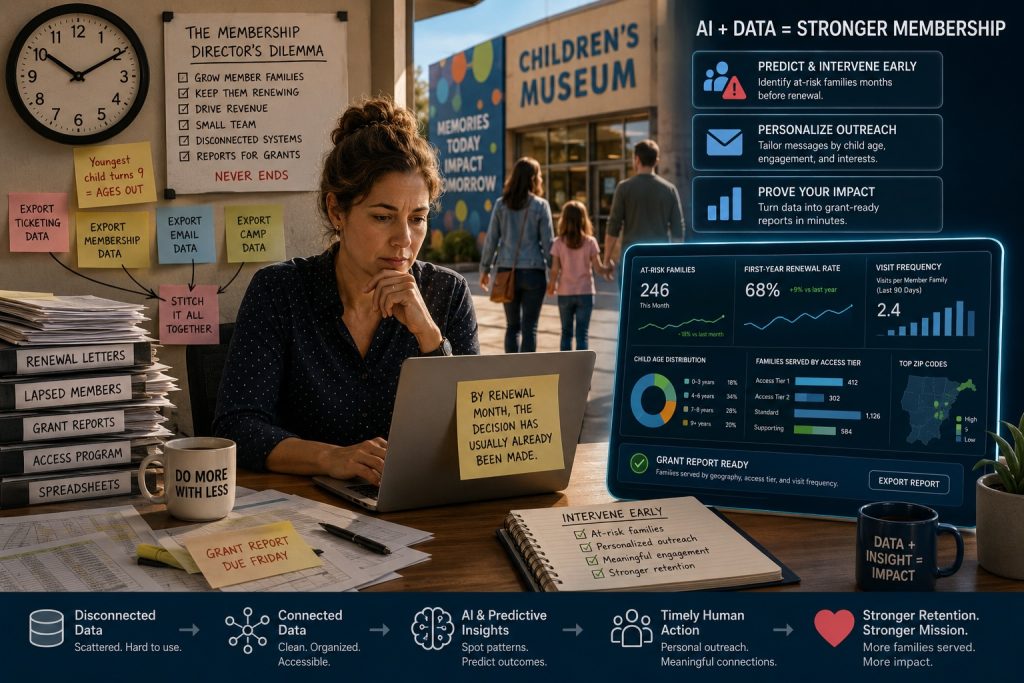
The Clock You Can’t Stop
Start with the challenge nobody puts in the job description: at a children’s museum, every membership comes with a built-in expiration date. It isn’t the renewal date. It’s the day the youngest child turns nine.
This is worth sitting with, because it changes what “retention” even means. A membership director at a children’s museum isn’t fighting ordinary churn — the kind a gym or a streaming service fights. She’s fighting a demographic clock. Industry surveys bear out how hard this is: a majority of cultural organizations report flat or declining membership, and children’s museums sit at the difficult end of that curve because their audience literally ages out of the product.
The conventional response is to work the renewal campaign harder. More letters, more emails, a phone-a-thon in the lapse month. And here’s the uncomfortable truth we watched play out across hundreds of organizations: by renewal month, the decision has usually already been made. The families who visited often in their first few months renew. The families who came twice don’t. The renewal campaign is arriving at the end of a story that was written at the beginning.
The Membership Data You Have but Can’t Use
The second challenge is quieter. Most membership directors are sitting on genuinely valuable data they cannot get to.
The ticketing system knows every time a member family scanned in. The membership platform knows the join date and the payment history. The email tool knows who opens what. The camp registration system knows the kids’ ages. These systems rarely talk to each other, so the questions that matter most — Which families are drifting away? What’s our renewal rate for families whose oldest child is seven? How many low-income households did we serve this year? — can’t be answered without someone spending a day stitching exports together. Usually that someone is you.
This matters beyond operations, because membership data has a second job most organizations never assign it: it is the documentation engine for grants. Funders don’t fund institutions; they fund populations served, and they fund evidence. “Four hundred families joined through our access-tier program, and here’s their visit frequency by zip code” is the sentence that unlocks six-figure program grants. If producing that sentence takes two days of manual work, it mostly doesn’t get produced.
What AI Can Do for Membership Retention
Now the part where we’re supposed to tell you AI fixes everything. It doesn’t. (We wrote about why nonprofit leaders should think about AI as a workforce earlier in this series.) But the honest version is still encouraging, because the problems above — predicting who will lapse, personalizing outreach, and turning raw records into reportable evidence — happen to be exactly the problems this generation of tools is good at.
The evidence comes mostly from the fundraising side of the nonprofit world, which is a few years ahead of membership in adopting these tools. Greenpeace, working with the AI platform Dataro, used machine-learning lapse predictions to retain donors who would otherwise have walked away — and found that the model surfaced at-risk segments their traditional segmentation had missed entirely. Parkinson’s UK, in results published by the same platform, saw response rates above 14 percent on AI-selected appeal audiences versus about 9 percent for their conventional selects — roughly a 23 percent revenue lift from the same file. Animal Haven, a New York animal shelter, reports a 264 percent increase in recurring donors since adopting AI-personalized giving experiences through Fundraise Up.
We’ll add the caveat the vendors won’t: these numbers are self-reported or vendor-published, and you should read them the way an experienced operator reads any case study — as directional evidence, not a guarantee. But the direction is consistent, and the underlying technique transfers directly to membership. A lapse-propensity model doesn’t care whether the record says “donor” or “member family.”
Closer to home, the pattern is already reaching visit-driven organizations. The Smithsonian’s National Museum of African American History and Culture has used predictive analytics on its e-ticket data to forecast demand and study attrition — proof that the scan data most museums already collect can be mined rather than archived. And platforms serving YMCAs and JCCs, like Daxko, now build at-risk scoring on forty-plus data points per member directly into their software, with organizations like the Siegel JCC in Delaware reporting higher retention and — notably — more members crossing over into donors after automating their engagement outreach.
For a membership director, the practical translation looks like this. An at-risk flag that fires when a family’s visits drop off, months before the renewal date, while there’s still time to intervene. Renewal communications segmented by the age of the children, so the family whose youngest is turning nine gets a grandparent-membership or donor invitation instead of a fourth identical renewal letter. And a grant report — families served, by geography, by access tier, with visit frequency — produced in minutes instead of days.
The Part Everyone Skips
Two warnings, from a team that has watched a lot of technology projects succeed and fail.
First: every one of the results above rested on a foundation of clean, connected, exportable data. That is the unglamorous precondition. Sometimes an organization can start on the subset that’s already clean — renewal emails need little more than names, dates, and children’s ages — while the foundation work happens in parallel. Sometimes the honest answer is that the foundation has to come first. Knowing which situation you’re in is the real judgment call, and it’s the question to press any consultant or vendor on before you sign anything.
Second: a churn score is worthless if nobody acts on it. A prediction that the Hendersons are drifting away only matters if someone has the time — and a plan — to reach out to the Hendersons. In a three-person membership department, the intervention capacity has to be designed alongside the intelligence. Otherwise you’ve bought a very sophisticated way to watch families leave.
And before any of it: decide how you’ll measure success — a theme we explored in Don’t Swing Harder. Capture the baseline — today’s renewal rate, today’s first-year renewal rate, today’s hours spent on manual reporting — before anything changes. Organizations that skip this step end up, a year later, with a feeling instead of a result.
The Job Deserves Better Tools
Membership directors have been asked for years to do knowledge work with clerical tools — to somehow intuit which of three thousand families are drifting, while spending their actual hours exporting spreadsheets. The technology finally exists to flip that ratio: let the software watch the patterns, and let the humans do what only humans can do, which is call a family and make them feel like the museum would miss them.
That’s not a story about replacing anyone. It’s a story about a hard job finally getting the tools it deserved all along.
Sagient Partners was founded by John Rees and Joe Garappolo — technology veterans with 75+ combined years of experience, four companies founded, and two exits — who for 25 years have built software for and consulted to nonprofits, including museums, zoos, and cultural attractions.
Sources & attributions: Greenpeace and Parkinson’s UK results as published by Dataro; Animal Haven results via CCS Fundraising; NMAAHC predictive analytics via The Old State; Daxko and Siegel JCC via Daxko. Figures are vendor- or self-reported and should be read as directional.