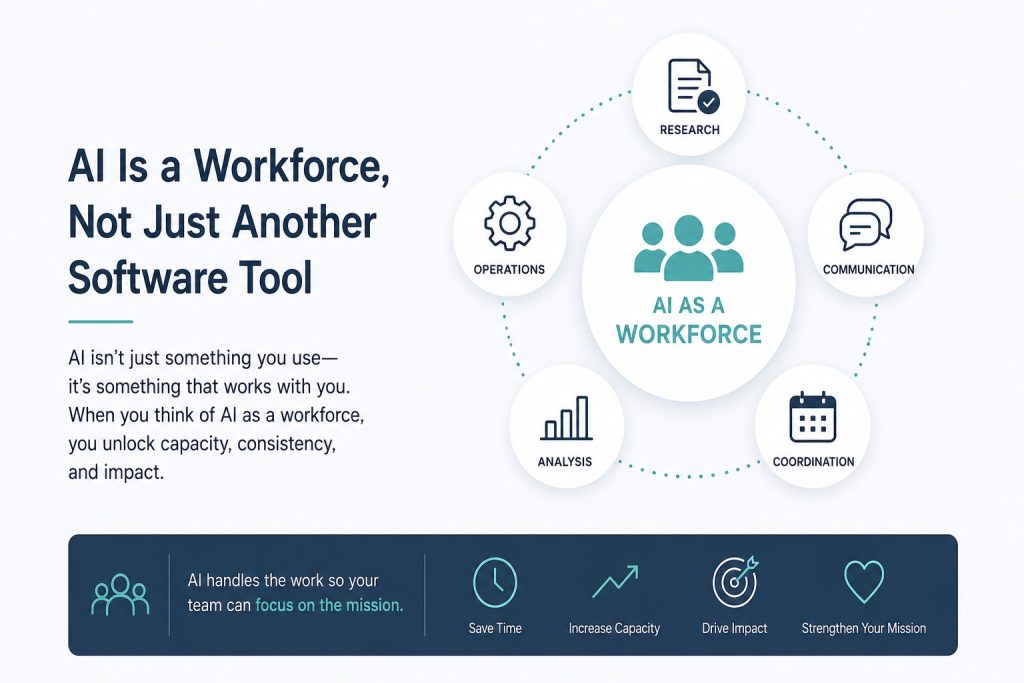
For the past year, nearly every conversation I’ve had with nonprofits has eventually arrived at the same place. Someone asks, “So…what are we supposed to do about AI?” It’s a fair question, but I don’t think it’s the right one. Before deciding what to do with AI, we first need to understand what AI actually is and acknowledge that it is evolving rapidly. AI is not a new software tool. It is a new kind of workforce.
Every decade or so a new technology arrives that promises to change everything.
- The internet connected people.
- Cloud computing made information available anywhere.
- Mobile devices put computing in our pockets.
Artificial Intelligence is different. It doesn’t simply connect or store information. It performs work.
That may sound like an odd way to describe technology, but it’s the simplest way for nonprofit leaders to understand what is happening. Many organizations begin with the wrong question: “What AI software should we buy?” That’s like shopping for a hammer before deciding what you’re trying to build. AI isn’t simply another application to install. It’s a new kind of workforce.
Until Now, Only People Could Perform Work. AI Changes That.
Until now, only people could perform work. Software could store information and automate narrow, rigid tasks — but anything requiring judgment, context, or adaptability required a person. AI changes that. For the first time, organizations have a new kind of workforce: one that can understand context, adapt to new situations, and perform work the way an employee would. For nonprofits, that distinction matters. Most organizations aren’t trying to replace people — they’re trying to help dedicated staff and volunteers accomplish more with limited budgets, growing expectations, and finite time. Think of AI as adding digital coworkers to your organization. These coworkers don’t replace your mission — they help you fulfill it.
The Assistant
This is what the industry calls Generative AI — and it’s what most people have experienced through tools like ChatGPT. An AI assistant helps people work faster by drafting newsletters, summarizing board meetings, creating volunteer training materials, outlining grant proposals, translating communications, and preparing first drafts. Think of it as an eager intern — fast, capable, and always available — but whose work still requires human review.
The Expert
This is Generative AI grounded in your own data — often called RAG (Retrieval-Augmented Generation), though the term matters less than the capability. Unlike The Assistant, which is focused on creating, The Expert is focused on querying and interpreting what your organization already knows. It uses generative AI under the hood, but the defining characteristic is that it is grounded in your specific data: your member records, donor history, volunteer logs, program outcomes. Instead of asking staff to build reports, leaders can simply ask questions — Which members attended three events but haven’t renewed? Which volunteers haven’t served in six months? Which donors have increased their giving? — and get immediate, accurate answers. The better your data, the better your expert.
The Agent
An AI agent performs complete workflows. Imagine a digital membership coordinator that notices upcoming renewals, drafts personalized messages, schedules reminders, updates your CRM, and alerts staff to unusual situations. Or a volunteer assistant that answers questions, prepares orientation materials, and reminds volunteers about upcoming shifts. The staff member doesn’t disappear. The repetitive work does.
Why This Matters for Nonprofits
Businesses often adopt AI to reduce labor costs. Nonprofits have a different opportunity. Every hour saved on repetitive administration is another hour available for the work that actually advances the mission:
- Recruiting and supporting volunteers
- Cultivating donor relationships
- Serving members more personally
- Strengthening programs
AI doesn’t just save time. It increases mission capacity.
AI Doesn’t Replace Judgment
AI can summarize a board meeting, but only your leadership understands the politics behind the discussion. AI can draft a donor letter, but only your development team understands the relationship. AI can recommend actions — people remain responsible for deciding whether those actions are right. Judgment, empathy, ethics, and relationships remain human responsibilities.
The Real Question
The question isn’t whether your nonprofit should use AI. The better question is: What work prevents our staff and volunteers from spending more time advancing our mission? Answer that first. Then determine whether AI is the right solution.
Throughout this series we’ll explore how AI can:
- Strengthen volunteer programs
- Improve data quality
- Preserve institutional knowledge
- Prepare nonprofits for a future where people and AI work together
Looking Ahead
This series is not about technology. It’s about leadership in the age of AI. We’ll examine how nonprofit leaders can build organizations that are more resilient, more knowledgeable, and more mission-focused. The technology will continue to evolve, but the leadership principles will endure.
Sagient Partners was founded by John Rees and Joe Garappolo, 40-plus-year technology veterans who have built, scaled, and sold technology businesses across consulting, SaaS, and AI implementation. Visit us at https://sagientpartners.com to see how we can help you.