By Sagient Partners
We’ve reported to, presented to, and sat beside a lot of nonprofit executive directors, and we came to believe two things about the role: nobody carries a wider job, and nobody’s time is spent further from the reason they took it.
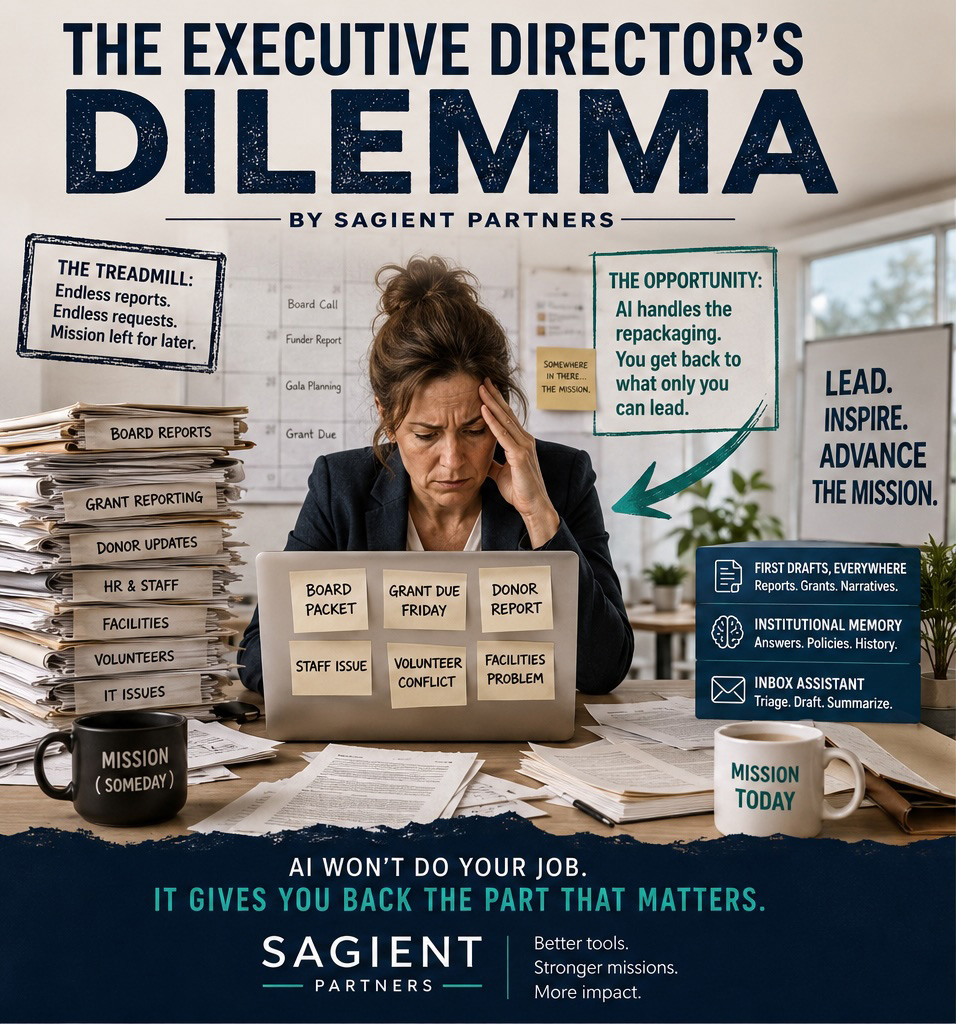
Chief fundraiser. Head of HR. De facto IT director. Facilities manager when the boiler goes. Chief volunteer wrangler — including the one who has chaired the gala for fifteen years and does it her way. Author of the board packet, the annual report, and every grant narrative. Somewhere in there — usually evenings — the actual mission work.
As with the rest of this series, we’ll name the problem plainly before we get specific about where AI earns its place, and where it doesn’t.
The Job That Ate the Mission
The standard guidance says an ED should spend roughly a quarter of their time fundraising. Layer on board management, staff issues, vendor decisions, and the endless production of documents, and the mission gets what’s left — usually the smallest slice.
This isn’t a time-management failure; it’s structural. In a small organization, everything that doesn’t clearly belong to someone belongs to the ED. The organization’s throughput becomes one person’s calendar. And the sector is feeling it: the share of nonprofit chief executives who call burnout “very much” a concern jumped to 46 percent, up from 29 percent the year before, and roughly a third intend to leave within two years. Behind each of those numbers is a board that will spend a year and a real salary replacing someone who mostly needed the job to be doable.
The Reporting Treadmill
The most corrosive work is the most invisible: assembling the same information, over and over, in slightly different shapes. The board wants a monthly packet. The funder wants a quarterly report in their template. The grant due Friday wants the same program outcomes as the last one, framed for a different funder.
None of it creates new knowledge — it repackages what the organization already has. And in most nonprofits, the repackaging is done by hand, by the most expensive and most exhausted person in the building, because only the ED holds the full picture.
What AI Can Actually Do
We’re not going to tell you AI hands you your calendar back. It won’t. (We covered what AI really is — and isn’t at the start of this series.) But an ED’s most time-consuming work — turning existing information into documents, and answering questions the organization has answered before — is exactly what this generation of tools does well.
The early evidence is directional but consistent: nonprofits using tools like Microsoft 365 Copilot report faster document production and fundraising gains of up to 20 percent, and a majority now use or plan to use AI in fundraising, with grant writing the most common entry point. Read vendor numbers as direction, not guarantee — but the direction matches our own client work. In practice:
First drafts, everywhere. The funder report drafted from program data in minutes. The board narrative assembled from the month’s numbers. The grant boilerplate generated from a source of truth instead of retyped. You still edit — you stop composing from a blank page.
Institutional memory that answers questions. When policies, board decisions, and funder requirements live in a knowledge base an AI can search, “ask the ED” stops being the only path to an answer. It also captures what otherwise lives only in a key volunteer’s head, so a fifteen-year departure stops being a crisis. This is the knowledge-dependent organization we’ve written about, and the ED is its biggest beneficiary.
A first pass on the inbox. Triage, routine replies, thread summaries. Not sending — drafting. The judgment stays yours; the typing doesn’t.
The Part Everyone Skips
Two warnings. First, AI output still routes through your judgment. A drafted grant narrative is not a submitted one — the voice has to be yours and the numbers have to be right. The gain is real, but it’s “two hours instead of ten,” not “zero instead of ten.” Second, if everything routes through your desk today, automation alone won’t fix that. Faster drafts just pile up at the same bottleneck. The tool has to arrive with a delegation decision: what no longer needs your review at all?
And before any of it, capture the baseline — a theme since Don’t Swing Harder. How many hours did last quarter’s board packet take? Write it down. A year from now you’ll want a result, not a feeling.
The Job Deserves Better Tools
Executive directors have been asked for years to be the institutional memory, the writing staff, and the reporting department — while also leading. The technology finally exists to hand off the repackaging and keep the leading: the donor lunch, the board relationship, the vision only a human can hold. That’s not a story about replacing anyone. It’s about giving the hardest job in the building back to the person who took it.
Sagient Partners was founded by John Rees and Joe Garappolo — technology veterans with 75+ combined years of experience, four companies founded, and two exits — who for 25 years have built software for and consulted to nonprofits, including museums, zoos, and cultural attractions.
Sources & attributions: CEO burnout figures via NonProfit PRO’s coverage of the State of Nonprofits 2026 research; departure-intention figure (Chronicle of Philanthropy 2024 CEO survey) as compiled by the Center for Non-Profit Coaching; Copilot nonprofit results via TechSoup; ED fundraising time guidance via FundraisingCoach. Figures are survey- or vendor-reported and should be read as directional.