There’s a particular kind of conversation I’ve come to value more than almost any other in business.
It’s not the one where someone walks in with a solution already in mind and wants you to validate it. It’s not the pitch meeting, or the demo, or the requirements document. It’s the conversation that starts much earlier — before anyone knows what the answer is — and it begins with a few simple questions.
What’s frustrating you? What takes too much of your time? What do you dread walking in on Monday morning?
These sound almost too basic. But the organizations that move fastest and get the most out of any new initiative are the ones willing to sit with those questions before they reach for a solution. Most skip straight to the solution. That’s where the trouble starts.
The Problem Beneath the Problem
When someone says they need a better scheduling system, or a new way to handle customer communications, or help evaluating AI tools — I’ve learned to slow down before I accept the premise. Because what they describe is rarely the actual problem. It’s the symptom they’ve learned to articulate.
The real question is: What would have to be true for this to stop bothering you?
Not what tool would fix it. Not what process needs to change. What would the world look like if this were no longer a problem? That question — asked sincerely, and followed wherever it leads — is where real discovery begins.
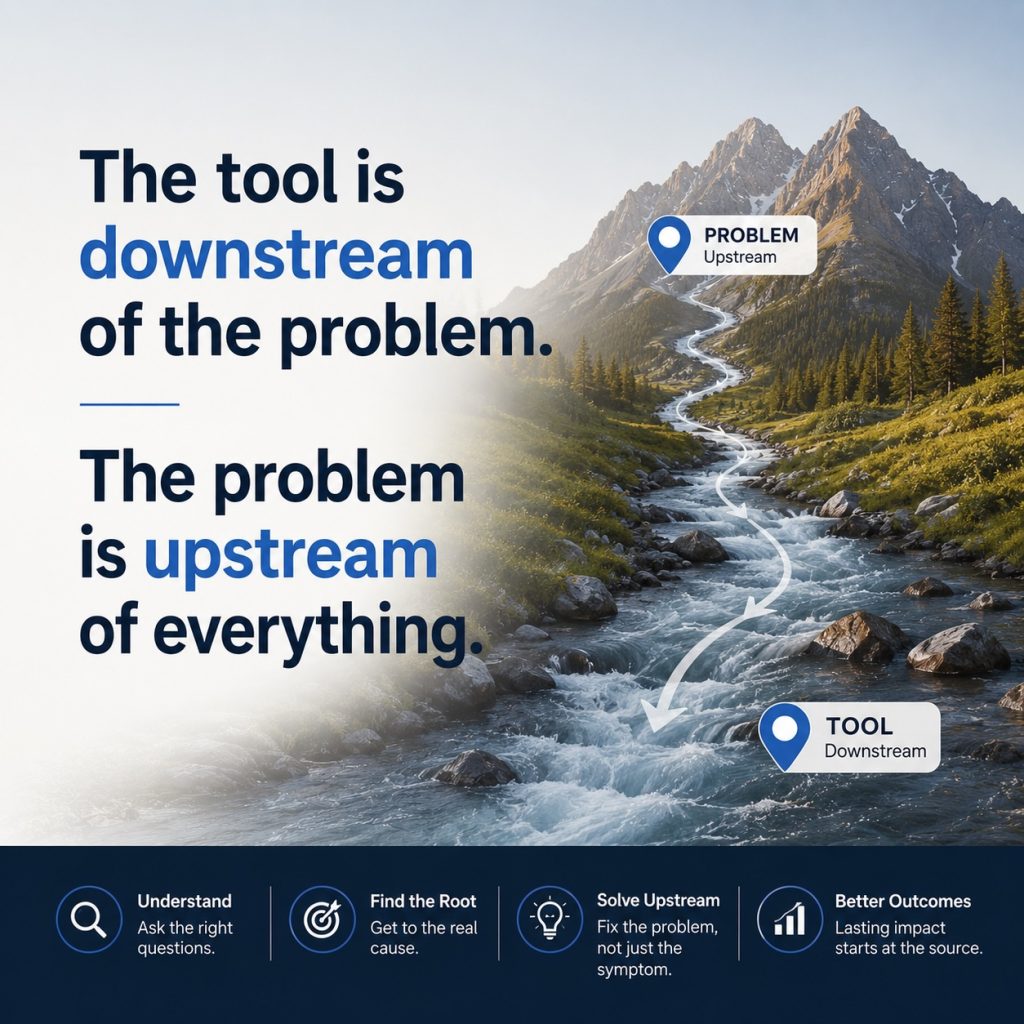
The tool is downstream of the problem. The problem is upstream of everything.
The Questions Worth Asking
If you’re trying to figure out where AI — or any meaningful change — could make a difference in your organization, I’d start here. Not as a checklist. More as a conversation you have with yourself, or with someone who’s willing to push back.
What keeps you up at night?
Not the big existential stuff, though that matters too. The operational things. The things you know are broken and can’t seem to fix. The things you’ve explained to three different people who’ve all moved on. The things you’re embarrassed haven’t been solved yet.
What do you do that you don’t like doing?
This one is underrated. There’s usually a reason you don’t like it — either it’s the wrong use of your judgment, or it’s repetitive in a way that feels wasteful, or it’s something you’ve inherited and never questioned. Any of those is a signal.
What are you waiting for?
Waiting is one of the most expensive things a business does, and it’s almost never measured. Waiting for a report. Waiting for an approval. Waiting for information that’s sitting somewhere in a system no one has time to pull. What’s the thing that has to happen before the next thing can happen — and does it have to work that way?
What would you do if you had the people and the time?
This question surfaces the vision that’s been quietly shelved. Most leaders know what they’d go after if constraints weren’t in the way. Articulating it — even roughly — tells you something about where the real leverage is.
What does success look like, and how would you know?
This one is harder than it sounds. Vague aspirations don’t generate traction. If you can describe what better actually looks like — and how you’d measure it — you’re already ahead of most organizations trying to figure out where to start.
Why This Matters More Now
We’re at a moment where the range of what’s actually possible — not theoretically possible, not “in a few years” possible, but right now possible — has expanded dramatically. AI tools that would have required a team of engineers two years ago can now be implemented in weeks. Workflows that were too complex to automate are now tractable. The ceiling has moved.
That creates a different kind of problem. When the range of options is wide and the marketing is loud, it’s easy to grab something that sounds right and discover later that it doesn’t fit. The organizations that are getting the most out of this moment aren’t the ones that moved fastest. They’re the ones that started with clarity about what they were actually trying to solve.
The tool is downstream of the problem. The problem is upstream of everything..
If you haven’t had that conversation yet — the one that starts with what’s broken, what’s waiting, what’s been shelved — it might be time to have it.
Joe Garappolo is a co-founder of Sagient Partners and a 40-year technology veteran who has built, scaled, and sold technology businesses across consulting, SaaS, and AI implementation.